
Summary
Editor's rating
Is it worth the money?
Looks: cosy from a distance, a bit tacky up close
Everyday use: quiet, simple, but not very adjustable
Build quality: light, a bit flimsy, but not total junk
Longevity: mixed feedback and one serious red flag
Heating performance: slow and steady, not a quick blast
What you actually get out of the box
Pros
- Quiet radiant heat with no fan noise, comfortable for long evenings
- Heats a medium-sized room steadily and warmth lingers after switching off
- Simple freestanding setup that fits nicely into an unused fireplace
Cons
- Cheap-looking gold trim and plasticky flame effect that many people dislike
- Build feels lighter and less durable than older models, with at least one serious safety complaint

Specifications
View full product page →| Brand | Dimplex |
Old-school electric fire vibes, modern reality check
I picked up the Dimplex Yeominster because I was fed up with noisy fan heaters that blast hot air for 10 minutes and then leave the room cold again. I also wanted something that looked a bit like the old school bar fires I grew up with, rather than another plastic tower. On paper, this one ticks a lot of boxes: 1.2 kW, two heat settings, no fan, and that fake glowing log bed for a bit of atmosphere.
In practice, it really does feel more like a traditional radiant fire than a modern fan heater. The heat is more gentle and spreads out better over time, instead of just frying your shins. I used it in a medium-sized living room and also in a bedroom to see how it behaved. Both times, I let it run for a couple of hours, then turned it off and checked how long the room stayed warm.
It’s not perfect though. The design is a bit of a mixed bag: the overall shape is fine and feels familiar, but some of the details look cheap or dated, and the fake flame effect is honestly not great. A couple of Amazon reviewers mentioned ripping out the flicker bits and I understand why. Also, if you’ve known the older Glen / Glen Dimplex versions, this one does feel a bit lighter and less solid.
So, if you’re expecting a heavy, metal, long-term appliance like the stuff from 30–40 years ago, you’ll probably be a bit disappointed. But if you want something simple, quiet, and capable of heating a room steadily without blasting dust into the air, it gets the job done. The rest is mostly about how much the look and small quirks bother you.
Is it worth the money?
In terms of value, I’d put the Yeominster in the “reasonable but not a bargain” category. You’re paying for the brand name (Dimplex has been around for ages), the traditional look, and the radiant bar style rather than a cheap plastic fan heater. For that, you get quiet operation, decent room heating, and a product that’s simple to use. If that’s what you’re after, the price makes sense.
However, you’re not getting premium materials, fancy features, or a particularly convincing flame effect. The design is a bit dated and some parts look cheap close-up. A basic oil-filled radiator or a modern convector with a thermostat can sometimes be found for less money and might heat a room more evenly, though they won’t give you that “fireplace” vibe. So you’re definitely paying a bit for the style and nostalgia factor, even if the build doesn’t fully live up to the old models.
Where it does score on value is the running cost versus fan heaters. A few users mention that, in practice, they found it cheaper to run because they could leave it on longer at a lower setting and the room stayed warm after switching it off. Obviously, electricity prices are what they are, and 1.2 kW is still 1.2 kW, but the way radiant heat works means you can often run it more steadily instead of constantly cycling it.
If you want pure heat for the lowest price, you can probably find something else. If you want a quiet, traditional-looking heater that you can drop into an unused fireplace and you’re okay with some cosmetic compromises, the value is pretty solid but nothing special. I wouldn’t import it at a huge cost like one reviewer did, but at normal UK prices, it’s a fair deal for what it offers.
Looks: cosy from a distance, a bit tacky up close
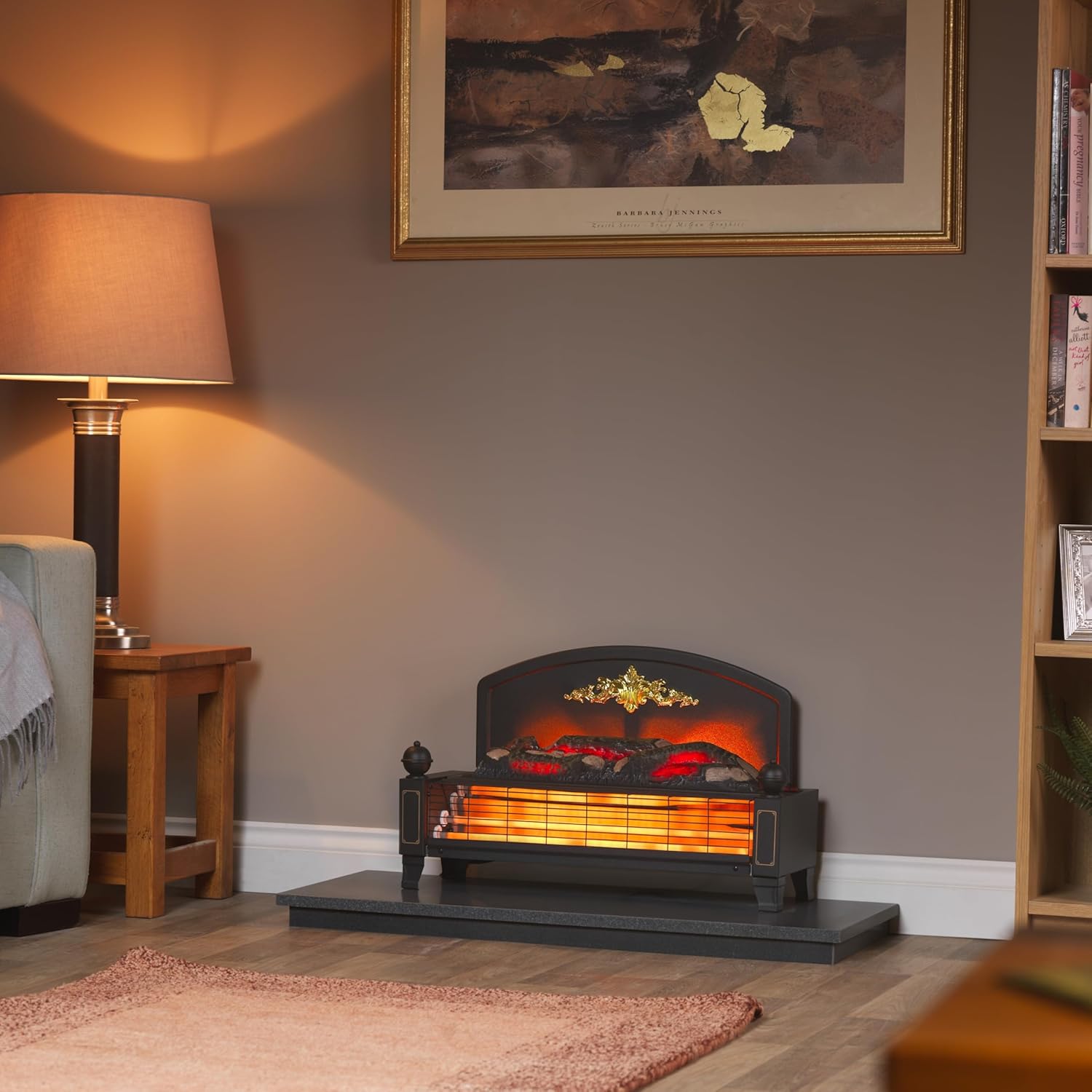
Design-wise, the Yeominster is trying hard to look like a traditional fire, and depending on how picky you are, it either passes or fails. From across the room, with the lights slightly dimmed, you get that classic black fire surround and a glowing area at the bottom, which does give the room a bit of a cosy feel. If that’s all you want, you’ll probably be happy enough.
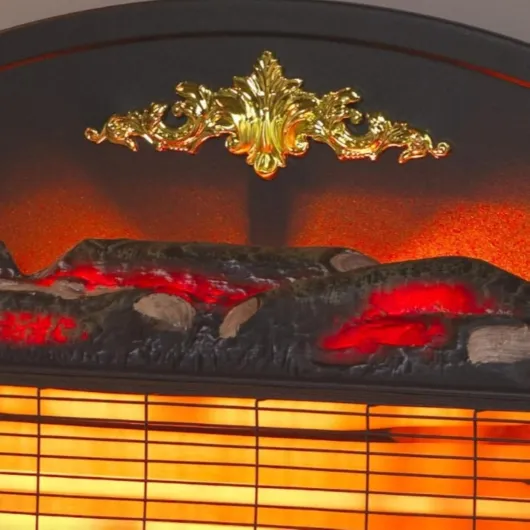
But when you get closer, you start noticing the details. The black body is okay, nothing fancy, just a basic lacquered finish on alloy steel. The part that bothered me, and that a lot of reviewers also mention, is the gold/brass effect trim on the back plate. It’s very bright and looks more like cheap plastic than metal. One reviewer compared it to the shiny gold lucky cat you see in some takeaways, and that description is spot on. If you like subtle, this is not it. If you’re a bit handy, you can tone it down with paint or even remove certain bits, and people have actually done that.
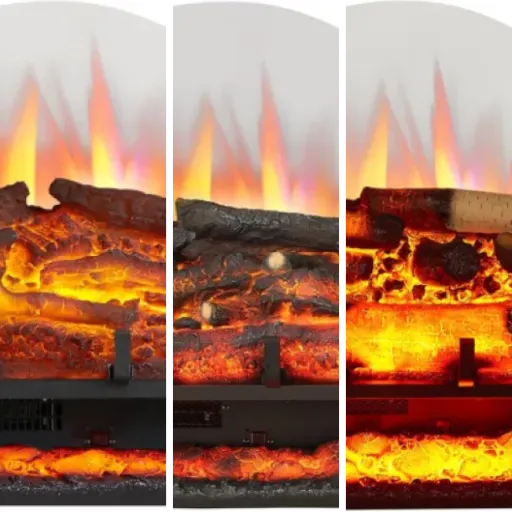
The fake log/ember bed is another point. It’s not the worst I’ve seen, but it does look plasticky. On the plus side, it’s easy to access and remove (just a couple of screws), which is handy if you want to swap the bulb, clean behind it, or even modify the internals like some users did (removing the flicker disk, for example). The flame effect itself is made by a rotating aluminium disk, which gives a flickering light. Personally, I found it a bit cheap and annoying, and I ended up mostly using just the glowing effect without caring about the fake flames.
So overall: from a distance, it looks decent and does the job of filling a fireplace opening. Up close, it’s clearly a modern budget product trying to copy an old look. If you want something that really looks like cast iron or high-end, this isn’t it. But if you’re realistic and maybe willing to tweak it a bit, you can make it look acceptable in a normal living room.
Everyday use: quiet, simple, but not very adjustable
In daily use, the Yeominster is pretty low-effort. You walk over, flick one or two switches, and that’s it. No menus, no beeps, no remote you lose down the sofa. For some people, that’s ideal. I used it mostly in the evenings when sitting on the sofa. If you’re within a couple of metres, you really feel the radiant heat on your legs and body, which is quite pleasant on cold nights. It’s similar to sitting in front of an old gas fire but without the smell or ventilation worries.
The lack of a thermostat is a double-edged sword. On one hand, it keeps things simple and there’s less to break. On the other, you might find yourself getting up to switch between 600 W and 1200 W, or turning it off and on again as the room warms up or cools down. If you like set-and-forget heating, this isn’t that. I ended up using the lower setting most of the time and just accepting a slower warm-up, which felt more comfortable and avoided overheating the room.
The silent operation is honestly one of the best aspects. No fan means no whirring, and also less of that dry, blown-air feeling. For people with asthma or sensitive airways, that can make a big difference. One reviewer said it didn’t affect their breathing like blow heaters do, and that lines up with how gentle the heat feels. You also don’t get that annoying hot-draft feeling on your face; it’s more like sitting near a warm wall.
On the downside, the flame effect can be irritating if you’re sensitive to flickering lights. The rotating disk makes a constant flicker as soon as the flame function is on, and while the unit itself is quiet, the visual flicker is a bit much in a dark room. Some people actually removed the disk and toned down the bulb to get just a calm red glow. So from a comfort perspective: heat and noise are good, controls and visuals are a bit basic and not very refined.
Build quality: light, a bit flimsy, but not total junk
Let’s be honest: this is not built like the old Glen or Berry fires from decades ago. Those things were heavy, mostly metal, and felt like they’d survive a bomb. The Yeominster is lighter, uses more plastic, and you can tell they’ve cut some corners to keep the price down. The main body is alloy steel with a lacquered finish, but a lot of the decorative bits are clearly plastic – especially the gold/brass effect trim and parts around the ember bed.
When you tap the casing or move it, it doesn’t feel like it’s going to fall apart, but it also doesn’t give that solid, premium impression. A reviewer who owned the older Glen Prilect version for 20 years called this one “cheap and tacky” by comparison, and I get where they’re coming from. The fuel bed is now a log effect rather than coal, and it’s lower and less bright than the old model, which makes the visual effect less punchy.
On the inside, from what users who opened it up have said, the design is fairly simple. The elements are accessible and replacements are not too expensive, which is a plus for long-term use. One person mentioned that elements for the older Berry were hard to find and pricey, but for the Yeominster they’re easier and cheaper. That’s not exactly high-end engineering, but at least it’s maintainable. The flicker mechanism is literally a small motor spinning an aluminium disk – basic, but easy to remove if it annoys you.
So, in short: materials and build are acceptable for the price, but don’t expect old-school durability or a premium feel. If you want something that looks and feels more solid, you’ll probably have to pay more and maybe move away from this very traditional style. If your expectations are “decent heater that might last several winters if treated properly”, this fits that bracket.
Longevity: mixed feedback and one serious red flag
This is where things get a bit more serious. Most users seem happy with how it holds up over a few winters, and a lot of the reviews are from people using it as a regular heater without problems. However, there is at least one worrying review where the unit apparently burst into flames after around four years of light, seasonal use. That’s not something you just ignore, even if it’s only one case out of many.
Putting that aside for a second, the general durability feedback is mixed but not disastrous. People who switched from older brands like Berry or Glen say the Yeominster feels less solid and doesn’t give the same bright, cheerful glow. Those older fires lasted 20–40 years in some cases. This one probably won’t. It feels more like a 5–10 year product if you’re lucky and take care of it. The upside is that replacement elements are easier and cheaper to source, so if a bar fails, you don’t necessarily have to bin the whole thing.
Personally, I’d treat this as a secondary heater and follow common-sense safety: don’t cover it, don’t leave it running unattended, and make sure the plug and socket aren’t overheating. Check the cable occasionally. With any electric heater, especially cheaper, lighter ones, that’s just standard practice in my book. The built-in overheat protection is there, but I wouldn’t rely on it as your only line of defence.
So, durability verdict: better than a bargain-bin fan heater, worse than the old beasts from decades ago. If you expect 20 years of service, you’ll likely be disappointed. If you want something to get you through a run of cold winters and you’re okay replacing it eventually, it’s acceptable. Just be aware of that one serious negative review and act cautiously, like you would with any plug-in heater drawing over 1 kW.
Heating performance: slow and steady, not a quick blast
On performance, the Yeominster does what a 1.2 kW radiant heater is supposed to do. Don’t expect it to instantly turn an icy room into a sauna. It’s more of a gradual, steady heater that gives a nice, even warmth if you leave it on for a while. I tested it in a medium-sized living room, around 18–20 m², with average insulation. On the 600 W setting, it takes the edge off the cold but won’t fully heat the room if it’s really chilly outside. On the full 1200 W, after about an hour or so, the room felt comfortably warm, and the warmth stayed around a bit after turning it off.
Compared to fan heaters I’ve used, the big difference is the way the heat feels and how long it lasts. Fan heaters blast hot air, but the room cools down quickly once they’re off. With this radiant style, the heat seems to soak into the room more slowly, and the temperature drop after switching off is less brutal. One Amazon user mentioned that the warmth lingers, and I’d agree with that. It’s not magic, it’s just the way radiant heating behaves versus forced air.
Another strong point: it’s silent. No fan noise, no humming. If you’re sensitive to noise, especially in a bedroom or while watching TV, this is a big plus. I could have it on while watching a film and completely forget it was there, except for the warmth. People with breathing issues also seemed to prefer this over fan or convector heaters, probably because it doesn’t stir up dust in the same way.
One thing to keep in mind: 1.2 kW is not huge. For very large or badly insulated rooms, this is more of a support heater or something to sit in front of, rather than your main heating. But for a normal UK living room or bedroom, used sensibly, it’s enough. It also seems reasonably efficient for what it is – no fancy eco mode, just straightforward resistive heating, but users report it being cheaper to run than some fan heaters they replaced, mainly because they don’t need to crank it on and off all the time.
What you actually get out of the box
Out of the box, the Dimplex Yeominster is pretty straightforward. You get one main unit, no remote, no assembly, no weird extras. You literally pull it out of the packaging, put it where you want it, and plug it in. For people who hate DIY or drilling into walls, that’s a plus. It’s a freestanding heater, so you can slide it into an old fireplace opening or just park it against a flat wall in the living room.
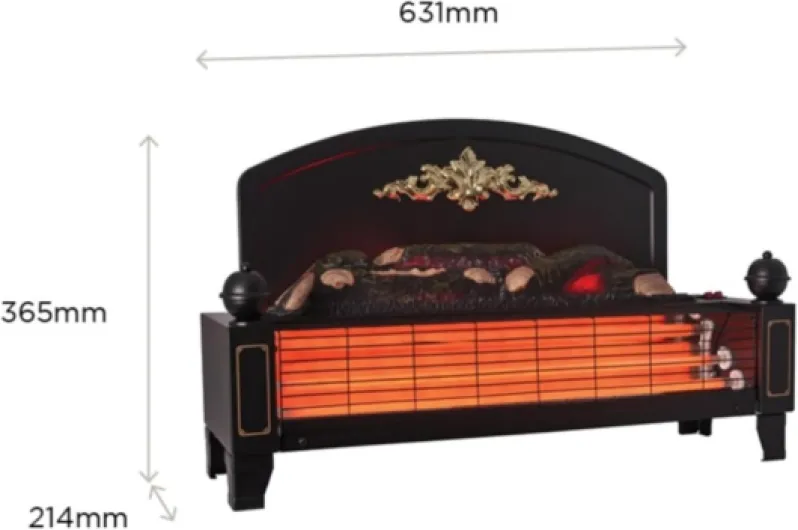
The dimensions are roughly 63 cm wide, 36.5 cm high, and 21.4 cm deep, and it weighs about 5.3 kg. That means it’s light enough for one person to move around without effort but not so light that it feels like a toy. It has two heat settings (600 W and 1200 W), and then a separate flame effect that you can turn on without the heat. The controls are simple rocker switches on the top edge: one for the flame effect and one for each bar.
There’s no fancy thermostat, no app, no timer. It’s very basic: on or off, bar 1 or bar 1+2. That can be seen as a good thing or a bad thing depending on how much control you want. If you’re used to modern oil-filled radiators with digital displays and timers, this will feel a bit primitive. But if you just want to walk over, flick a switch and feel heat, it’s exactly that.
In terms of safety, it has overheat protection and a safety cut-out, which is kind of the minimum you’d expect these days. I wouldn’t leave it on unattended or overnight, but that’s how I treat any plug-in heater. Overall, the presentation is simple and honest: an old-school style radiant bar fire with a fake log bed and basic controls. Nothing clever, but you know what you’re dealing with in two minutes.
Pros
- Quiet radiant heat with no fan noise, comfortable for long evenings
- Heats a medium-sized room steadily and warmth lingers after switching off
- Simple freestanding setup that fits nicely into an unused fireplace
Cons
- Cheap-looking gold trim and plasticky flame effect that many people dislike
- Build feels lighter and less durable than older models, with at least one serious safety complaint
Conclusion
Editor's rating
The Dimplex Yeominster is basically an old-school radiant bar fire dressed up for modern living rooms. It heats a medium-sized room steadily, it’s quiet, and it doesn’t blow dust around like fan heaters. If you sit a couple of metres in front of it on a cold evening, it does exactly what you want: gentle, direct warmth and a bit of a cosy glow. The controls are simple and anyone can use it without reading a manual.
On the downside, the build and aesthetics are a mixed bag. The shiny gold trim and plasticky log bed look a bit cheap close up, and the flame effect is more annoying than realistic. Some people even end up modifying it to tone things down. Durability also isn’t at the level of the older Glen or Berry fires – this feels like a mid-range appliance, not a 20-year workhorse. The one report of it catching fire is a serious negative, so I’d treat it with the same caution I’d give any plug-in heater: don’t leave it on unattended and keep an eye on it.
Who is it for? People who want a quiet, traditional-looking, plug-in heater to fill an empty fireplace or act as a main evening heater in a living room or bedroom. Especially good if you hate fan noise or have breathing issues with blown-air heaters. Who should skip it? Anyone wanting premium materials, a really convincing flame effect, advanced controls, or bulletproof long-term durability. For the price, it’s a decent, practical option – not perfect, not high-end, but it gets the job done if you know what you’re buying.