
Summary
Editor's rating
Value for money: solid heater if you know what you’re buying
Design: basic black bar that blends into the background
Materials & build: sturdy heater body, so-so accessories
Durability & real-world use: holds up well, with a few weak points
Performance: strong directional heat, but only if you’re in the zone
What you actually get out of the box
Pros
- Heats people and objects in front of it quickly with three useful power levels (900W, 1200W, 1500W)
- Sturdy aluminum heater body with IP55 rating, suitable for covered outdoor and garage use
- Easy to mount and run on standard 120V with a simple remote and almost silent operation
Cons
- Only heats a focused zone; not effective for warming large or windy open spaces
- Remote and mounting brackets feel cheap and could be more robust

Specifications
View full product page →| Brand | DR. INFRARED HEATER |
A wall heater for when you’re sick of freezing on the patio
I’ve been using the DR Infrared Heater DR-238 for a bit now on a small covered patio and in a garage corner, and I’ll be blunt: it’s not magic, but if you’re within its beam, it does the job. This is not a heater that turns your whole patio into a cozy bubble. It’s more like a heat lamp: if you’re in front of it, you’re good; if you’re off to the side, you’re not. Once you understand that, it becomes a pretty solid tool instead of a disappointment.
In practice, I mounted it on a wall about 7 feet high, angled down towards a seating area. We’re talking a space for 2–3 people, not a big outdoor dining room. On the medium and high settings (1200W and 1500W), you actually feel the heat on your face and upper body within a minute or two. When the air is in the low 40s°F, it’s enough to sit and have a drink without shivering, as long as there’s not a strong breeze blowing through.
What surprised me most is how quickly it ramps up. You press the remote, and the orange glow kicks in almost instantly. No long warm-up like some old-school space heaters. It’s also quieter than I expected: there’s basically no noise except a faint click when you change settings. For a garage workout or watching a game in the man cave, that’s pretty handy—no fan hum in the background.
It’s not perfect. If you expect it to heat a wide-open deck in the wind, you’ll be disappointed. And the mounting hardware is functional but feels a bit cheap, so I took my time making sure it was secure. Still, for a reasonably priced 120V plug-in heater that doesn’t need a gas line or a special circuit, it’s a decent upgrade over sitting there in a jacket, especially in shoulder seasons.
Value for money: solid heater if you know what you’re buying
In terms of value, the DR-238 sits in a pretty reasonable spot. It’s not the cheapest infrared bar heater on the market, but it’s also nowhere near the high-end stuff you see in fancy restaurants. For the price, you get a heater that mounts easily, runs on standard 120V, has three power levels, a remote, and is rated for both indoor and outdoor use. With an average rating around 4.3/5 and a high sales rank in outdoor heaters, it’s clearly doing something right for a lot of people.
Where you get the most value is if your use case fits its strengths. Examples where it makes sense:
- Heating a specific seating area on a covered patio or deck.
- Warming a workbench zone in a garage or workshop.
- Providing heat over a kennel or pet area like in some reviews.
- Creating a warm "man cave" corner in a garage with a TV and a couple of chairs.
On the downside, if you’re trying to heat a large, open backyard, a super drafty garage, or a commercial-size outdoor dining area with just one of these, you’ll probably feel underwhelmed. You’d need multiple units and a decent layout to cover a big space, and at that point, the total cost climbs quickly. Also, the lack of a built-in thermostat on this version means it’s more of a simple on/off, pick-a-level approach. If you want more precise temperature control, you’d either need a different model or some DIY solution.
Overall, I’d say the value is pretty solid: you’re paying for a functional, reliable heater with decent build quality and a simple user experience. You’re not paying for fancy design, smart features, or premium accessories. If you go in with realistic expectations—that it heats you, not the whole outdoors—then for the price, it’s a good deal. If you expect it to behave like a full HVAC system for your patio, you’ll be disappointed and feel like it’s overpriced.
Design: basic black bar that blends into the background
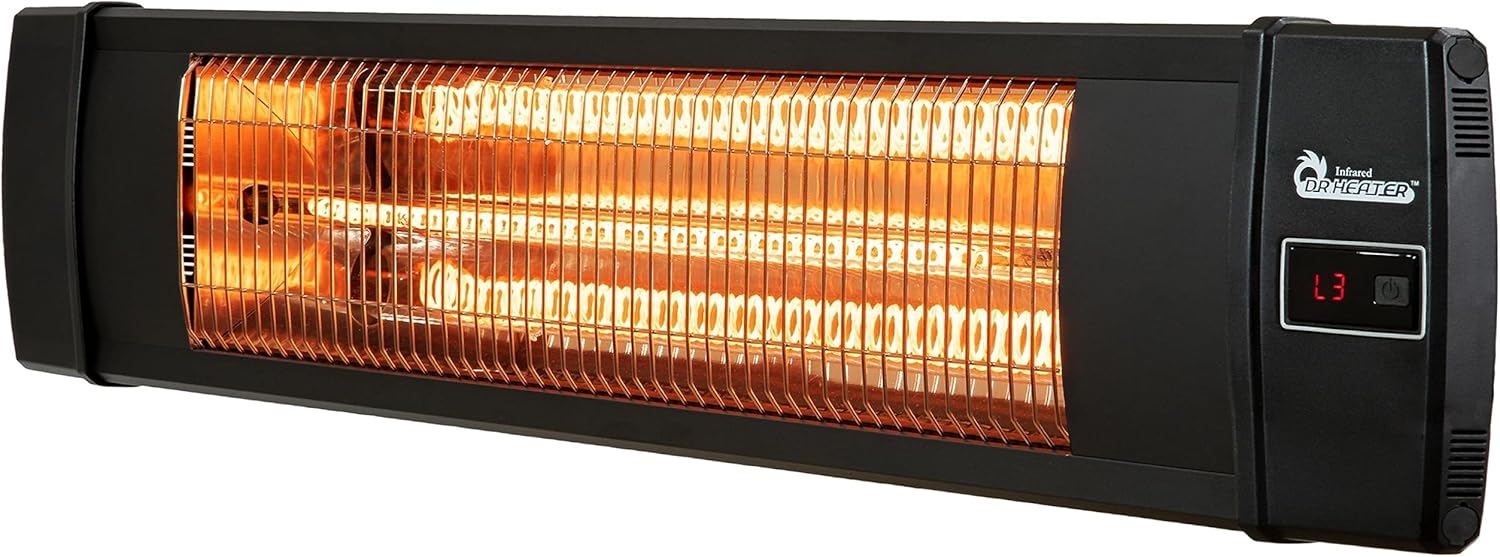
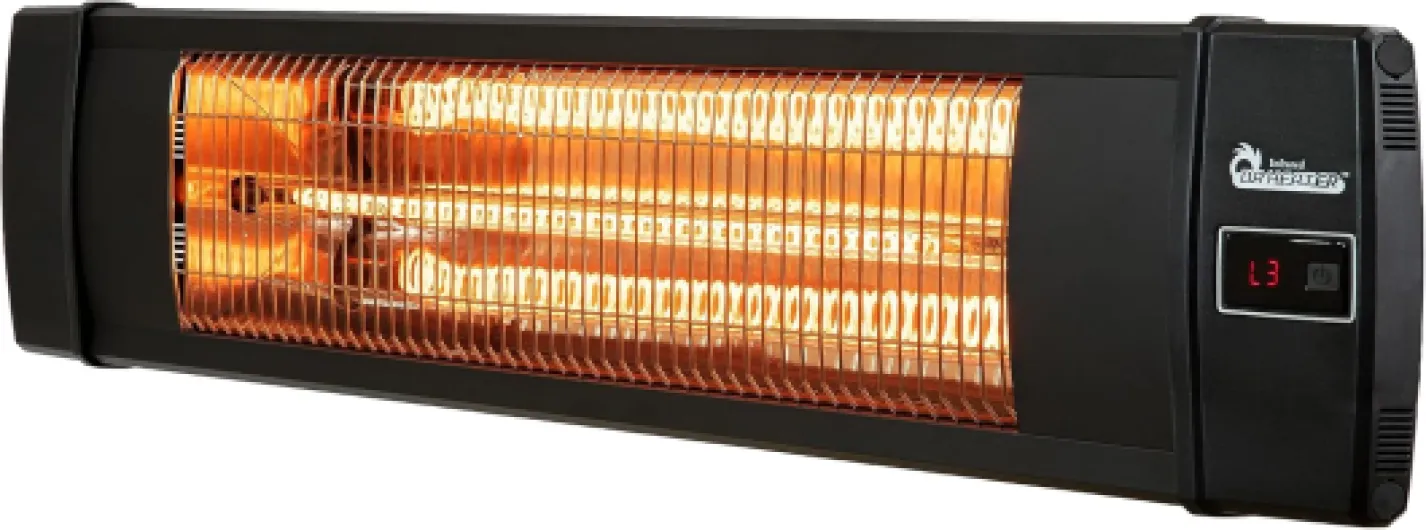
Design-wise, this thing is pretty plain, and that’s not a complaint. It’s a black aluminum bar with a grill on the front and brackets on the back. Once it’s up on the wall or ceiling, it basically disappears until you turn it on and see the glow. If you’re trying to keep your patio from looking like a hardware store, the neutral black works fine. It doesn’t scream for attention, which is good if you already have lights, decor, or a TV in the area.
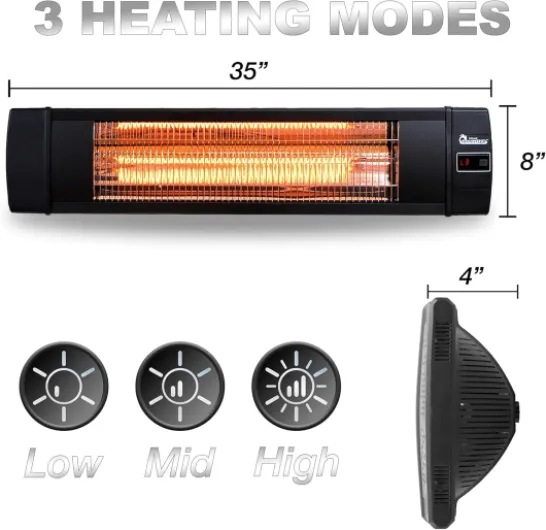
The form factor is long and narrow—roughly 35" x 8" x 4"—so it fits well above a sliding door, along a garage wall, or under a patio roof. The weight is around 8 pounds, so you’re not dealing with some massive gas tower heater. Still, I’d recommend mounting into studs or using decent anchors, especially if it’s going overhead. The included brackets pivot, which is important because the heater is directional. You want to be able to tilt it toward the seating or workout area instead of blasting heat into open space.
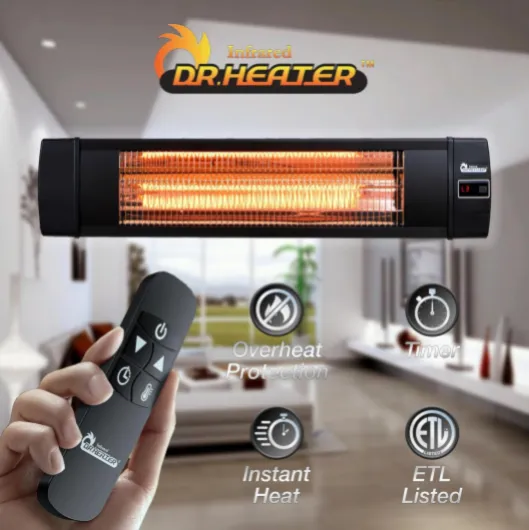
One thing to keep in mind: the heater glows orange when it’s on, so if you’re picky about ambiance, you’ll notice it. Personally, I don’t mind; it actually helps visually confirm it’s running from a distance. The control panel is minimal—no giant digital screen, just enough to show the level and timer. The remote is small and honestly feels a bit cheap, but it does the job. I’ve seen people tape the battery door because it’s flimsy, and I get why. This is probably the weakest part of the design.
Overall, the design is very functional: slim, mountable, directional. No fancy curves or premium finishes, but it fits in garages, workshops, kennels, and patios without looking out of place. If you want something that looks super high-end for a designer outdoor lounge, this might feel a bit plain. But if your priority is to mount it quickly and forget about it, the design makes sense and doesn’t get in the way.
Materials & build: sturdy heater body, so-so accessories
The main body is made from anodized aluminum, and you can feel that it’s not flimsy sheet metal. The casing feels solid when you grab it to position it, and there’s no rattling or weird flexing. For something that’s supposed to live outdoors or in a garage, that’s important. You don’t want rusted steel or cracked plastic after one winter. The IP55 rating means it’s rated for dust and water jets, so light rain and humidity shouldn’t be an issue, as long as you mount it sensibly and don’t point it straight into a storm.
The reflector inside is advertised as a high-reflectivity mirror aluminum with about 90% reflectivity. I can’t measure that, but in practice, you can tell it throws a fairly focused beam of heat instead of just warming itself. When you stand under it, there’s a clear hot zone. That suggests the internal materials are doing what they’re supposed to. The grill on the front is also metal and feels decent enough; you’re not meant to handle it when it’s on anyway, but it doesn’t feel like it will bend from a light bump.
Where the materials feel cheaper is the mounting hardware and the remote. The brackets work, and they do pivot, but the metal isn’t thick. For a light 8-pound heater, it’s acceptable, but they don’t inspire much confidence when you first handle them. If you’re mounting in a spot where a failure would be a real problem (like above a car or somewhere people walk), I’d at least double-check your installation or even consider beefier brackets if you’re handy. The screws and anchors included are basic; I’d personally use my own wall anchors for anything but solid wood.
The remote is plastic and feels like the kind you get with cheap LED lights. It works, and it’s easy to understand, but the battery door is not great. Some buyers end up taping it shut. I’d treat it as a small consumable part: if it dies in a couple of years, you won’t be shocked. The heater itself, though, feels like it should handle several seasons outside if you don’t abuse it. Given the price and the 1-year limited warranty, I’d say the materials on the main unit are pretty solid, but the accessories are clearly where they saved a few bucks.
Durability & real-world use: holds up well, with a few weak points
From what I’ve seen and from digging through a lot of user feedback, the DR-238 holds up pretty well over time, especially considering the price. The anodized aluminum body doesn’t rust, and the unit seems fine with being left mounted outside under some cover. I wouldn’t mount it where it’s getting hammered by direct rain all the time, but for a covered patio, open garage, or screened porch, it’s built for that kind of environment. People are using these in garages, workshops, kennels, and outdoor dining areas for multiple seasons without constant failures, which is a good sign.
The heating element is carbon infrared, which typically lasts longer than some cheaper quartz tubes. There are plenty of reviews from folks who’ve bought multiple units over the years for different spaces because the earlier ones kept working. That tells me it’s not just surviving one winter and dying. Of course, like any electric heater, things can fail—especially the electronics or the remote—but there’s no big pattern of them all dying after a short time, which you sometimes see with bargain heaters.
The weak points for durability are mostly small details: the remote, the battery door, and the basic mounting hardware. The remote feels like it could crack if it hits concrete hard enough. The battery door doesn’t snap in as securely as it should, so taping it is not a crazy idea. As for the brackets, they’re fine if you install them properly into solid material, but I wouldn’t trust the included wall anchors in crumbly drywall or brick. Spending a few bucks on better anchors or bolts is worth it for peace of mind.
There’s a 1-year limited components warranty, which is standard at this price. It’s not a long coverage, so if you’re expecting a 5-year guarantee, you won’t get that. In practice, if it survives the first season without any issues, chances are good it’ll keep going. Overall, I’d rate durability as good for the main unit, average for the accessories. If you treat it as a semi-permanent installation and protect it from the worst weather, it should serve you for several winters without much drama.
Performance: strong directional heat, but only if you’re in the zone
This is where things either work for you or not, depending on your expectations. The DR-238 is an infrared radiant heater. That means it heats objects and people in front of it, not the air in the whole space. If you’re expecting it to turn a drafty garage into a warm living room, you’ll be disappointed. But if you treat it like a heat lamp focused on a working or sitting area, it performs pretty well.
On the three settings—900W, 1200W, and 1500W—you can feel a clear difference. In my use, here’s roughly how it plays out:
- 900W (Level 1): Fine for cool evenings (high 40s to 50s°F) if you’re within 4–6 feet and not in wind. Good for taking the edge off while you’re at a workbench or sitting with a light jacket.
- 1200W (Level 2): This is my default. In the low to mid 40s°F, you can sit under it in a hoodie and feel comfortable in a small area. In a two-car garage, two units on L2 can keep a corner useable.
- 1500W (Level 3): For colder nights or when you’re further away. You feel a noticeable blast of warmth on your face and torso, but it’s still not going to fix a strong cross-breeze.
Warm-up time is basically instant. Within 10–20 seconds, you feel heat on your skin. That’s a big plus compared to heaters that take several minutes to ramp up. The heat coverage is a cone, not a bubble; from about 5–7 feet away, you’re in the sweet spot. Any further, and it drops off quickly. In a partially enclosed patio or behind wind screens (like the guy using it in dog kennels), it works much better than in a fully open deck. Wind is the big enemy here—if cold air is constantly blowing between you and the heater, you’ll feel less benefit.
Noise is basically a non-issue. There’s no fan, so it’s almost silent. That’s great for watching TV, working, or just hanging out without a constant hum. In terms of safety, it feels stable once mounted and the front grill keeps you from touching the element directly, but obviously, it’s still hot, so you don’t want kids reaching up to it. Overall, the performance is pretty solid as long as you understand it’s meant to warm a specific zone, not the whole outdoors.
What you actually get out of the box
Out of the box, the DR-238 is pretty straightforward: one long heater bar, mounting brackets, screws/anchors, a remote, and the power cord already attached. No thermostat on this version, just three power levels (900W, 1200W, 1500W) and a timer via the remote. The overall feel is more "practical shop gear" than "designer patio object", which I’m fine with. It’s about 35 inches long, so it covers a decent width if you mount it above a bench or a small table.
The heater has a simple front grill with the carbon heating element behind it. When you turn it on, you see a warm orange glow—not super bright, but noticeable. There’s a basic display that shows the power level and timer, so you at least know if you’re on low, medium, or high. No app, no Bluetooth nonsense, just a remote with big, obvious buttons. For an outdoor heater, that’s exactly what I want: less to break and less to fiddle with when it’s cold.
Installation-wise, the brand sells it as "plug and go", and that’s mostly accurate. It runs on a standard 120V outlet at about 12.5 amps on high, so you don’t need a special circuit, but you also don’t want to run this and a big space heater or compressor on the same line. The included brackets let you mount it on a wall or ceiling and pivot it roughly 180 degrees, so you can point the heat where you actually sit or stand. For most people, it’ll take longer to measure, drill, and decide on a spot than to actually attach the thing.
In real use, the simplicity is the main selling point. You hang it, plug it in, and then your daily interaction is basically just the remote: on/off, choose the level, maybe set a timer. No complicated setup, no menu. If you’re looking for something that integrates into a full smart-home ecosystem, this isn’t it out of the box, though you can toss it on a smart plug like some users do to cut power on a schedule. But if you want a basic, predictable source of radiant heat, the feature set is enough without being bloated.
Pros
- Heats people and objects in front of it quickly with three useful power levels (900W, 1200W, 1500W)
- Sturdy aluminum heater body with IP55 rating, suitable for covered outdoor and garage use
- Easy to mount and run on standard 120V with a simple remote and almost silent operation
Cons
- Only heats a focused zone; not effective for warming large or windy open spaces
- Remote and mounting brackets feel cheap and could be more robust
Conclusion
Editor's rating
After using the DR Infrared Heater DR-238 in a couple of different setups, my take is pretty simple: it’s a solid, no-nonsense radiant heater that works well if you stay in its line of fire. The build of the main unit is sturdy, the heat output is legit for a small zone, and it’s convenient to just mount it, plug it into a standard outlet, and control it with a remote. For garage corners, workshop benches, covered patios, kennels, or a man cave setup, it gets the job done without much fuss.
It’s not perfect. The mounting brackets are a bit flimsy, the remote feels cheap, and if you expect it to heat a big, windy area, you’re going to be underwhelmed. It’s a spot heater, not a whole-yard solution. There’s also no thermostat on this version, so you’re basically choosing a power level and maybe using a timer or smart plug to control runtime. But considering the price, the IP55 rating, and the generally positive long-term feedback, it lands in a good place for someone who wants practical warmth, not a showpiece.
If you have a small to medium zone you want to make more usable in colder months and you can mount this so it points directly at where you sit or work, it’s worth buying. If you’re trying to turn a massive open deck into a fully warm space with one unit, skip it or be ready to buy several. For what it is—a straightforward carbon infrared bar heater—it’s pretty solid value and a reliable way to stop freezing in one specific spot.