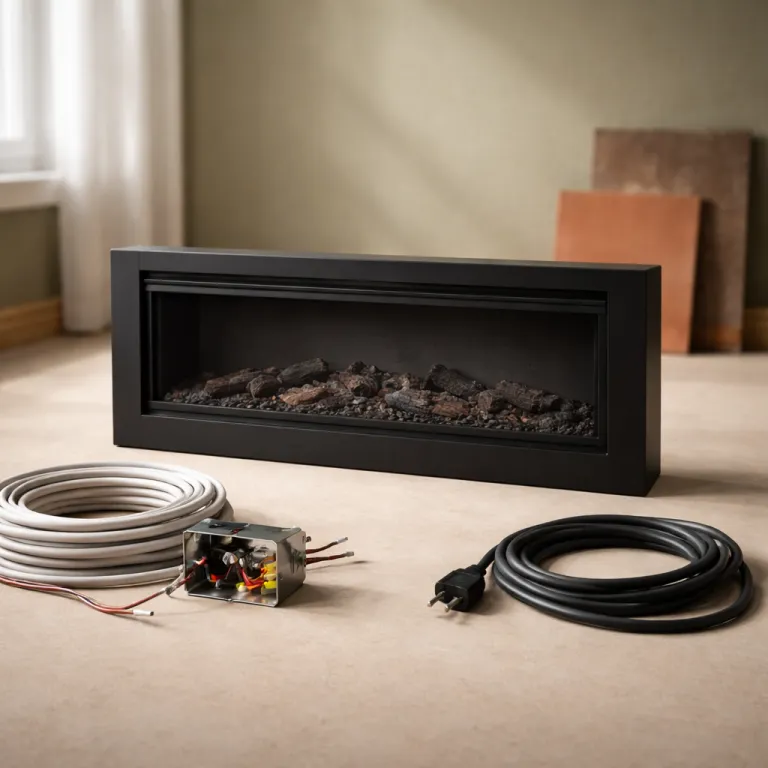

Why some electric fireplaces must be hardwired, not plugged in
When you plan an electric fireplace hardwire installation, the first decision is voltage and load. A wall mounted or recessed unit rated for 240 volts is treated like a fixed heating appliance under the National Electrical Code (NEC), and that rating alone usually means the fireplace will need a hardwired branch circuit rather than a simple cord and plug connection. Under NEC 422.10(A) and 422.16(B) in the 2020 NEC, most high wattage, permanently installed space-heating appliances cannot rely on a flexible cord as the primary wiring method. Many homeowners see a power cord in the box and assume they can just install electric models anywhere, but the label on the unit and the installation manual tell the real story.
Look at the data plate on the back or inside the firebox before any fireplace install work begins. If the electric fireplace shows 240 volts and a higher wattage than typical plug in electric fireplaces, the manufacturer instructions will usually state that an electrician must remove the cord and connect the unit directly to a junction box in the wall. This step is not optional, because a 240 volt fireplace insert on a cord can overload an outlet and turn a cosy wall fireplace into a code violation under NEC rules for fixed space-heating equipment and overcurrent protection in Articles 210 and 422. Major brands such as Dimplex and Touchstone spell this out in their installation manuals, which typically require a dedicated circuit, field wiring compartment, and hardwired connection for built in models, and those manuals always take precedence over generic advice.
Built in fireplaces that sit behind drywall follow the same logic, even at 120 volts. Once the wall covers the existing firebox or new framed opening, any outlet must remain accessible for inspection and replacement, so a recessed electric fireplace with a hidden power cord cannot legally rely on a buried receptacle in many jurisdictions. NEC Article 100 in the 2020 NEC defines “accessible (as applied to equipment)” as reachable without damaging the building finish, and NEC 210.52 and 406.5 reinforce that receptacles are intended to remain serviceable. In practice, that means a hardwired electric fireplace is the only compliant choice for most fully recessed fireplaces, while surface mounted units that hang on the wall can usually keep their plug and outlet visible and still meet manufacturer and local authority guidance.
Decision tree for a wall mounted or recessed fireplace install
Think of electric fireplace hardwire installation as a three branch decision tree that you can walk through before framing. First branch is voltage, where 240 volt electric fireplaces almost always require a hardwired circuit, while 120 volt fireplaces can be either plug in or hardwired depending on the wall design and the total amp draw. Second branch is whether the unit is truly wall mounted on brackets like a television, or recessed into an opening that mimics a traditional wood burning fireplace or masonry firebox.
Surface mounted fireplaces such as the Touchstone Sideline or many Dimplex wall fireplace models hang on the wall with their power cord visible. These units are designed so you can install electric heaters on a standard 120 volt outlet, although performance improves when that outlet sits on a dedicated 15 amp circuit sized according to NEC Article 210. If you later decide to close the wall around the unit and create a more built in look, that change turns a simple fireplace step into a full electric fireplace hardwire installation project because the receptacle may no longer be considered accessible.
The third branch is whether any existing fireplace or existing firebox is involved. When you slide a fireplace insert into an existing firebox, you must read the manufacturer instructions carefully, because some insert fireplace products allow a plug while others require hardwire once the surround closes the fireplace opening. For a clean result that rivals the best electric built in designs, many homeowners choose to remove the old burning fireplace, frame a new recessed opening, and plan a hardwired junction box exactly where the unit will connect, similar to how a Cadet Com Pak electric wall heater is wired in a dedicated cavity with a listed junction box and cable clamp.
Annotated decision-tree diagram (text version)
- Voltage check:
• Nameplate 120 V, ≤ 1 500 W → can be cord-and-plug or hardwired, depending on accessibility and wall design.
- Mounting style:
• Surface mounted on brackets with exposed cord → plug into a visible receptacle on a 15 A or 20 A branch circuit sized per NEC 210.19 and 210.20.
- Existing firebox:
What accessible receptacle really means for recessed electric fireplaces
Most confusion around electric fireplace hardwire installation comes from the phrase accessible receptacle. Under common electrical codes, including the NEC definition of “accessible (as applied to equipment)” in Article 100, an outlet must remain reachable for inspection, testing, and replacement without damaging the building finish, which means you cannot bury it behind drywall, tile, or a permanently fixed fireplace insert. Once you understand that rule, many recessed wall fireplace projects clearly fall on the hardwire side of the line.
Imagine a wall mounted unit that is only partially recessed, with a removable trim or access panel that lets you reach the outlet behind the firebox. Some manufacturers design electric fireplaces this way and explicitly allow a plug, as long as you follow manufacturer guidance about clearances, service openings, and cord routing. Other brands, especially higher wattage gas electric style hybrids or deep insert fireplace models, state in their installation manuals that the outlet cannot sit inside the framed cavity, so the electrician must route cable to a junction box and complete a hardwired fireplace install instead.
Where homeowners get into trouble is copying a social media build without reading any manufacturer instructions or local authority guidance. A popular shortcut is to frame a shallow niche, add an outlet inside the fireplace opening, and then close everything with drywall and shiplap so only the glass of the electric fireplace shows. That looks clean on day one, but it violates the requirement for an accessible outlet in many codes and can also conflict with the wiring rules for electric fireplaces explained in NEC Articles 210 and 422, so the safer path is to hardwire the unit and keep all junctions reachable from an adjacent cavity, service panel, or listed access door.
When a dedicated circuit and electrician are worth the cost
Most 120 volt electric fireplaces draw between 750 and 1 500 watts, which technically fits on a shared 15 amp circuit under typical load calculations. In a real living room with a television, lamps, and maybe a portable heater, that shared load often trips breakers, so a dedicated circuit for your electric fireplace hardwire installation is less luxury and more basic reliability. If you plan to run the heater function daily, especially in a bedroom or open plan space, ask your electrician to pull a new line from the panel and size the breaker according to the nameplate rating.
Hardwired 240 volt fireplaces, such as some larger Dimplex Revillusion or Real Flame built in units, always need their own breaker and appropriately sized cable. These models can deliver more heat than plug in electric fireplaces, but they also expose weak spots like fan noise, thermostat drift, and dimming flame LEDs after several winters of use, so sizing the circuit correctly is only one part of a durable fireplace install. A careful electrician will label the breaker clearly, route the cable away from sharp framing, and ensure the junction box sits exactly where the unit’s flexible conduit can reach without strain, following both NEC requirements and the manufacturer’s wiring diagram and installation booklet.
Even if your chosen fireplace insert ships with a plug, you can still choose to install electric connections on a dedicated circuit for better performance and fewer nuisance trips. This is especially helpful when converting an existing fireplace or existing firebox, where old wiring may be undersized, aluminum, or shared with lighting circuits. A short conversation about load calculations, breaker size, and future upgrades with a licensed electrician costs far less than repairing scorched outlets or tracking down intermittent trips once the drywall and mantel are finished and the burning fireplace look is meant to be the only drama.
Practical circuit examples
• A typical 1 500 W, 120 V wall mounted fireplace often lands on a 15 A, 120 V branch circuit using 14/2 NM-B cable with ground and a single-pole 15 A breaker, assuming no other large loads share that circuit and the installation follows the manufacturer’s amp rating.
• A 3 000–4 000 W, 240 V built in heater commonly uses a 2-pole breaker sized to the unit’s nameplate amperage, with conductors such as 12/2 NM-B on a 20 A circuit or 10/2 NM-B on a 30 A circuit, to satisfy NEC 210.19(A) conductor sizing and 210.20(A) overcurrent protection rules.
Planning the wall, framing, and inspection for a built in unit
Once you commit to an electric fireplace hardwire installation, the wall build becomes a coordination exercise between framing, wiring, and inspection. Before any drywall goes up, you and your contractor should agree on the exact fireplace opening size, the height of the junction box, and the route of the cable from the panel to the framed cavity. This is the moment to decide whether the unit will be fully recessed like a traditional firebox or slightly proud of the wall on brackets, because that choice affects clearances, wiring access, and how any access panels will be detailed.
For a clean result, mark the centerline of the wall fireplace and measure the manufacturer’s specified distance from the floor to the bottom of the unit. The electrician can then mount a metal junction box either inside the stud bay behind the firebox or in an adjacent cavity, depending on how the electric fireplace connects, and follow manufacturer instructions about strain relief, conductor length, and bonding. Many installers place the junction box between 12 and 18 inches above the finished floor for low, media-wall style fireplaces, or roughly at mid-height behind taller portrait units, always matching the template in the installation manual. When the drywall crew arrives, they must cut precise openings for both the fireplace insert and any access panels, so it pays to read the installation manual together and walk through each fireplace step on site, especially where the manual calls out minimum clearances to combustibles.
Permit requirements for electric fireplaces vary widely between municipalities. Some inspectors treat a hardwired insert fireplace like any other fixed appliance and insist on a permit and final inspection, while others focus only on structural work and leave the wiring to the electrician’s licence and NEC compliance. Either way, you protect yourself by keeping a copy of the manufacturer instructions, panel labels, and any recall notices, and by staying informed through safety focused resources from testing laboratories or local building departments, because the real test is not the log pattern in the showroom, but the tenth winter in your living room.
Example wiring route for a built in fireplace
A common layout is to run NM-B cable from the service panel up into the ceiling joist space, across to the feature wall, then down a stud bay to a metal junction box located beside or behind the firebox opening. From that box, the electrician connects the fireplace’s factory whip using wire connectors and a listed cable clamp, leaving enough conductor length for servicing, as required by NEC 300.14, and documenting the route in the project file or installation notes.
Key statistics on electric fireplace hardwire installation
- No specific global percentage of hardwired versus plug in electric fireplaces is consistently reported across markets, but higher wattage built in units are predominantly hardwired due to voltage, fixed-appliance rules, and accessibility requirements in common electrical codes such as the 2020 NEC.
- Standard 120 volt electric fireplaces typically draw between 750 and 1 500 watts, which fits on a 15 amp circuit but often benefits from a dedicated line for reliable heating performance and reduced breaker trips.
- Many 240 volt electric fireplace models require removal of any supplied power cord and must be hardwired directly to a junction box, because cords and concealed outlets conflict with common electrical code requirements for fixed space-heating equipment.
- Electrical codes in multiple jurisdictions require that receptacles remain accessible without removing permanent building finishes, which effectively rules out hidden outlets behind drywall for most fully recessed fireplace installations and pushes designers toward hardwired connections.
Frequently asked questions about electric fireplace hardwire installation
Do all electric fireplaces need to be hardwired
No, not all electric fireplaces require hardwiring, because many 120 volt units are designed to plug into a standard outlet. Hardwiring becomes necessary when the unit is rated for 240 volts, when the installation buries the outlet behind drywall or a fixed surround, or when the manufacturer’s installation manual specifies a permanent connection. In those cases, codes about accessible receptacles and fixed appliances push you toward a dedicated hardwired circuit.
Can I hide the power cord behind the wall for a cleaner look
Running a detachable power cord inside a wall cavity is generally unsafe and often violates electrical codes and product listing conditions. If you want a clean, cord free look for a wall mounted or recessed fireplace, the correct method is to install electric wiring to a junction box and hardwire the unit or use a listed in-wall power kit designed for that purpose. This approach keeps all conductors rated for in wall use and maintains compliance with accessibility and fire safety rules described in the NEC and in manufacturer installation manuals.
When should I add a dedicated circuit for my electric fireplace
A dedicated circuit is strongly recommended when the fireplace will be a primary heat source or when the room already has several high draw devices on the same breaker. Even though many 1 500 watt fireplaces can share a 15 amp circuit under NEC load calculations, real world use with televisions, sound systems, and lighting often leads to nuisance trips. Pulling a new line during construction or renovation is usually cheaper and easier than upgrading after the wall is finished.
Do I need a permit to hardwire an electric fireplace
Permit rules depend on your local building authority, because some jurisdictions require permits and inspections for any new hardwired appliance circuit, while others only regulate structural changes and service upgrades. The safest approach is to ask your electrician to check with the local inspector’s office before work begins. Even when a permit is not strictly required, following code, using listed components, and keeping documentation of the installation protects you during future home sales or insurance claims.
Can I convert an existing wood burning fireplace to an electric insert
Yes, many homeowners convert an existing wood burning fireplace by sliding a purpose built electric fireplace insert into the old firebox. The key is to assess the condition of the existing firebox, plan how the power will reach the unit, and decide whether a plug or hardwired connection is appropriate under current codes and the manufacturer’s instructions. A licensed electrician can help you evaluate whether the existing fireplace opening and nearby circuits are suitable or whether a new dedicated line and junction box are needed for a safe, code compliant conversion.