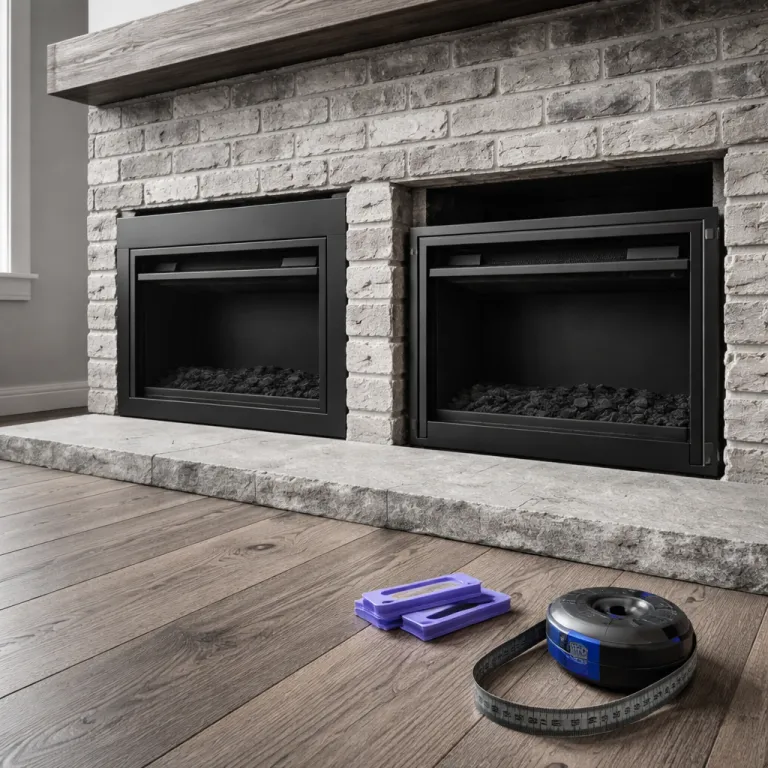
Why a 36 inch electric fireplace insert is rarely truly 36 inches
A so called electric fireplace insert 36 inch sounds straightforward. In practice, every electric fireplace manufacturer plays differently with trim, depth and clearances, so the real fit inside a masonry fireplace can surprise you. The gap between what the box says and what your hearth actually allows is where shimming, grinding and returns start to creep in.
Before you even list possible fireplace insert models, measure three things with a rigid tape. First, measure the width at the narrowest point of the firebox opening, not just the front of the brick fireplace, because damper hardware or a warped metal lintel often steals a precious half inch. Second, measure the depth from the finished hearth face to the back wall, because most inserts need between 20 and 35 cm of depth, and some inch recessed designs for a recessed wall demand more space than a shallow old firebox can offer.
Third, measure the height under the lintel, then again about 10 cm back, because many fireplace inserts are several inches high at the front but taller at the rear due to the heater housing. A so called standard 36 inch built opening can easily vary by 2.5 cm side to side, which means a trim kit that looked perfect on paper suddenly overlaps tile or leaves a crooked gap. When you compare options, treat the stated inch size as a marketing label, and the cutout dimensions as the only numbers that really matter.
Most homeowners focus on the flame and log visuals first. That is understandable, because a convincing flame with a deep ember bed and a realistic log set is what you stare at every night, yet the physical shell of the insert decides whether that flame ever reaches your living room. Think of the outer chassis and trim as a built electric puzzle piece that must slide into your existing firebox without forcing, tilting or blocking the fireplace heater vents.
In this guide we will look closely at how brands like Dimplex, Napoleon, SimpliFire and Touchstone Sideline describe their 36 inch recessed or wall mount compatible inserts. We will also examine when a wall mounted smart electric fireplace is actually a better choice than trying to force a too deep firebox into a shallow hearth. The goal is simple but demanding, which is to help you choose an electric fireplace that fits your masonry opening, your budget and your patience, not just your mood board.
The three measurements that matter in a 36 inch masonry opening
Start with width, because a standard 36 inch fireplace opening is rarely truly standard. Measure the brick or stone at the very front, then again 5 cm and 10 cm inside the firebox, and write each inch value down in a clear list. The narrowest number is the only one that counts, since your electric fireplace insert 36 inch must pass that point without scraping or binding.
Depth comes next and is where many projects fail quietly. A lot of electric fireplace inserts marketed for 36 inch built openings assume at least 25 cm of usable depth, yet older fireboxes often pinch down to 18 or 20 cm once you account for a sloping back wall. If your depth is tight, you may need a shallower model like the Dimplex Revillusion 30 inch firebox, which uses clever optics to project a deep flame without a deep chassis.
Height under the lintel is the third critical dimension. Some fireplace inserts are only 45 to 50 inches high at the front trim but rise several extra centimetres at the rear where the heater and fan sit, so you must compare both front and back height in the specification sheet. If your masonry opening arches or sags, measure at three points across the span, because a single low brick can block a supposedly compatible electric fireplace from sliding fully home.
Once you have those three numbers, you can start to compare real models instead of marketing labels. Look at the cutout or framing dimensions for each fireplace insert, not just the overall trim size, and pay attention to any note about inch recessed installation or recessed wall clearances. A unit that technically fits width and height but leaves only 1 cm of air space around the heater intake will run hotter, louder and probably fail sooner.
At this stage it helps to understand how a modern firebox works inside the metal shell. The heater, fan, LED flame engine and ember bed all compete for space, and the more cramped the chassis, the more likely you are to hear fan whine or feel hot spots on the trim. For a deeper explanation of how a firebox fireplace turns electric heating into a realistic focal point, see this detailed guide on how a firebox transforms electric heating into a focal point, then come back to your tape measure with fresh eyes.
Models that genuinely fit a standard 36 inch opening
Once the measurements are clear, certain electric fireplace insert 36 inch models consistently fit real world 36 inch hearths. The Napoleon Cineview 30 and 33 series, for example, are often recommended for masonry openings that measure between about 74 and 84 cm wide at the narrowest point, because their firebox chassis is compact while the trim stretches to cover small gaps. Consumer Reports testing has highlighted the Cineview insert as one of the strongest performers for heat output among inserts, which matters when you want the fireplace heater to do more than glow.
Dimplex offers several inserts that work well in this size range, including the Dimplex Revillusion 30 inch built electric firebox and some Dimplex inch models that are sold as 36 inch recessed ready units with generous trim. These Dimplex electric fireplace inserts usually pair a bright flame with multiple flame colors and a deep ember bed, and they often include a remote control with smart electric thermostat functions. When you compare Dimplex against a Touchstone Sideline or a SimpliFire Allusion, you will notice that the Dimplex firebox tends to be slightly deeper, which is fine in a roomy hearth but risky in a shallow one.
The Touchstone Sideline series is marketed heavily as a wall mount or recessed wall solution, yet several Sideline models can also slide into a masonry fireplace if the depth is adequate. A Sideline electric fireplace insert 36 inch equivalent usually offers wide inches of viewing area, adjustable flame brightness and multiple flame colors, but the chassis is often taller than a traditional insert, so inches high clearance under the lintel becomes critical. SimpliFire Allusion Heritage inserts, by contrast, are designed specifically for existing fireplaces and often include trim kits that respect the typical 36 inch opening without adding unnecessary bulk.
When you read product pages, pay attention to stock status and shipping notes. A model that looks perfect on paper but is out of stock for months may push you toward a compromise, yet rushing into a different insert with the wrong depth or height will cost more in masonry work than waiting for free shipping on the right unit. For a deeper dive into how lab tests evaluate these products, including the Napoleon Cineview and several Dimplex and Sideline models, see this analysis of what Consumer Reports insert lab tests reveal and what they miss.
Trim kits deserve special scrutiny. Some fireplace inserts ship with a standard trim that adds only a centimetre or two around the firebox, while optional wide inches trims can add 5 cm or more to each side, turning a snug fit into an overlap problem on your hearth. Always compare the bare firebox dimensions against your masonry opening first, then layer trim and aesthetic choices on top, rather than starting with the prettiest frame in the catalogue.
Shimming, trim kits and when a 36 inch insert is the wrong choice
Shimming sounds like a hack, yet in fireplace work it is often standard practice. If your electric fireplace insert 36 inch is a few millimetres narrower than the firebox, non combustible shims behind the side flanges can centre the unit and give the trim something solid to bite into. The key is to use shimming to fine tune a basically correct fit, not to force a fundamentally wrong model into a masonry opening.
When the gap exceeds about 1.5 cm on each side, you are no longer just shimming, you are compensating for a mismatch between the insert and the hearth. At that point a wide inches trim kit or a different fireplace insert size is usually the safer route, because large voids can create convection dead zones where hot air stagnates around the heater housing. Over time that extra heat can fade finishes, dry out mortar joints and shorten the life of the electric fireplace components.
Trim kits can also create problems when they are too large. A trim that adds 2 inches high on each side might look balanced on a product page, but in a real living room it can overlap adjacent tile, cover a mantel leg or crowd nearby wall mounted shelving. Always mock up the full outer dimensions with painter’s tape on the hearth and surrounding wall before you commit to a particular model and trim combination.
Sometimes the honest answer is that a 36 inch insert is simply the wrong tool. If your firebox is unusually shallow, or the lintel height is low, a wall mount or partially recessed wall unit above the hearth may deliver better results with less compromise. In those cases, a Sideline style built electric fireplace or a smart electric wall mounted unit can still give you adjustable flame effects, a convincing ember bed and a capable fireplace heater without fighting the old masonry.
Price often tempts people to force a marginal fit. A discounted Dimplex inch insert with free shipping can look irresistible compared with a more expensive custom sized firebox, yet the labour to grind brick, move a mantel or reroute wiring quickly erodes any savings. When you compare total project cost, include not only the price of the insert and trim, but also the time, dust and risk involved in making a non standard opening pretend to be standard.
Power, wiring and living with a 36 inch electric fireplace every day
Once the physical fit is solved, the next question is how the electric fireplace will actually run. Most electric fireplace insert 36 inch models draw up to 1 500 watts on high heat, which means about 12.5 amps on a standard 120 volt circuit, so you must check what else shares that line. If your living room already has a television, sound system and lighting on the same breaker, a hardwired connection on a dedicated circuit may be safer than a simple plug in.
Routing the cord or cable through the firebox deserves real thought. Many inserts allow the power cord to exit either side of the firebox, but older masonry fireplaces sometimes have only a small ash dump or damper opening, so you may need to notch brick or run conduit along the hearth. A clean installation hides the cable without crushing it, keeps the remote control receiver unobstructed and leaves enough slack to slide the insert out for service without disconnecting everything.
Daily use is where the difference between models becomes obvious. Some fireplace inserts offer a quiet, steady heater with a thermostat that holds within a degree or two, while others cycle loudly and drift several degrees, making the room alternately stuffy and chilly. Pay attention to user reports about fan noise after a few winters, because the cheap sleeve bearings in budget models often start to whine long before the flame LEDs fade.
Control options also shape how you live with the unit. A good remote control should adjust flame brightness, flame colors, ember bed intensity and heater output separately, so you can run the flame without heat on mild evenings or drop the heater while keeping a bright log set during a party. Smart electric features like Wi Fi control and voice integration are nice, but they should never replace a solid physical control panel on the firebox itself for those times when the app fails or the batteries die.
If you are planning a media wall, consider how the electric fireplace interacts with a television or built in cabinetry. Some homeowners prefer a wall mounted unit like a Sideline or similar model set higher on the wall, while others integrate a 36 inch recessed insert into a custom TV stand with a built electric compartment, as in this tested TV unit with a fireplace built in. Whatever you choose, remember that the best setup is not the one with the most features on the box, but the one that feels effortless on the hundredth evening when you just want quiet flame and reliable heat.
Flame realism, logs and what actually matters after the first week
In the showroom, everyone gravitates toward the brightest flame and the fanciest log set. The first week with a new electric fireplace insert 36 inch, you will probably cycle through every flame color, every ember bed pattern and every novelty mode just because you can. After that, most people settle into one or two favourite settings and start to care more about noise, heat distribution and how the unit looks when it is off.
Flame realism depends on three main elements. The first is the physical log set or media bed, whether that is traditional logs, clear crystals or a mixed ember bed, because the way light catches those shapes creates depth and movement. The second is the flame engine itself, which in better models uses layered LED projections and mirrored panels to create a taller, more random flame that looks less like a repeating pattern and more like a real fire.
The third element is how the firebox integrates with your room. A deep, matte black interior with a subtle brick pattern or herringbone liner hides reflections and makes the flame appear to float, while a shallow, glossy firebox can betray the illusion with visible hotspots and reflections of the heater grille. When you compare Dimplex, Napoleon, Sideline and other fireplace inserts, look not only at the flame but also at the dark areas around it, because that is where cheap models reveal their shortcuts.
Wall mount and wall mounted units often emphasise width over depth, offering wide inches of glass with a relatively shallow chassis. These can look striking in a modern room, especially when installed as an inch recessed feature in a recessed wall with clean drywall returns, yet they sometimes sacrifice log realism for a linear ember bed of glass or stones. If your heart is set on a traditional hearth look, a dedicated fireplace insert with a sculpted log set will usually age better than a purely linear design.
Over time, what matters most is how the electric fireplace feels in daily life. Does the heater quietly take the chill off a 20 square metre room without blasting hot air at your knees, and does the remote control respond reliably from the sofa. The real test of any model is not the flame pattern in the showroom, but the tenth winter in your living room.
Price, stock, shipping and how to compare value across brands
Budget is always part of the equation, yet price alone tells you very little about long term satisfaction. A mid range electric fireplace insert 36 inch from a reputable brand like Dimplex or Napoleon often outlasts a cheaper no name model that looks similar on paper, especially when you factor in heater reliability and spare parts availability. When you compare offers, think in terms of cost per winter, not just the sticker price on the day of purchase.
Stock and shipping conditions can nudge you toward hasty decisions. Retailers often highlight free shipping or fast delivery on certain fireplace inserts, while more specialised models with better fit for a 36 inch built opening may be back ordered. Waiting a few extra weeks for the right firebox is usually wiser than reshaping your hearth or settling for a unit that needs excessive shimming or awkward trim.
Look closely at what is actually included in the box. Some electric fireplace models ship with both a log set and a crystal ember bed, multiple trim options and a full function remote control, while others require you to buy trims, media and even wall mount brackets separately. A Sideline style unit might appear cheaper until you add the cost of a recessed wall kit, while a Dimplex inch insert with a comprehensive accessory pack and free shipping can end up being better value overall.
Warranty and support are part of value too. Established brands maintain parts stock and service networks, which matters when a fan motor or control board fails several years in, whereas obscure imports often leave you replacing the entire fireplace at the first serious fault. Read the fine print on heater coverage in particular, because some warranties quietly limit coverage on the very component that works hardest.
Finally, match the product to your actual use. If you mainly want ambiance with occasional heat, a simpler fireplace heater with modest output and strong flame realism may be perfect, while a basement family room might justify a more powerful insert with smart electric scheduling and precise thermostat control. Value is not about ticking every feature box in a list, but about paying for the specific performance and durability that your home and your habits genuinely require.
Key figures for 36 inch electric fireplace inserts
- Most 36 inch class electric fireplace inserts draw around 1 400 to 1 500 watts on high heat, which translates to roughly 4.8 to 5.1 kWh for a three hour evening session, according to typical manufacturer specifications for North American models.
- Standard masonry fireplaces marketed as 36 inch openings often vary by 2.5 to 5 cm in actual usable width, based on field measurements reported by chimney and hearth installers across multiple regions.
- Independent lab tests of electric fireplace inserts have found that real world heat output can be 10 to 20 percent lower than the nominal rating, due to fan efficiency and room airflow, which reinforces the need to treat BTU claims as approximate rather than absolute.
- Consumer testing organisations have reported that fan noise complaints increase sharply after three to five years of regular use, especially in budget inserts that rely on sleeve bearing fans instead of ball bearing designs.
- Surveys of homeowners upgrading from wood burning to electric fireplace inserts indicate that more than half underestimated the importance of depth and height measurements, leading to unexpected masonry work or returns in a significant minority of projects.
FAQ about 36 inch electric fireplace inserts
Will a 36 inch electric fireplace insert fit my existing 36 inch masonry fireplace
Not automatically, because the 36 inch label on both the insert and the fireplace is only a rough class size, not a precise fit guarantee. You must measure the actual width at the narrowest point, the depth to the back wall and the height under the lintel, then compare those numbers to the firebox cutout dimensions in the product specifications. A proper fit usually leaves a small air gap around the chassis for ventilation and allows the trim to cover any minor gaps without forcing the unit.
Can I plug a 36 inch electric fireplace insert into a standard wall outlet
Most residential electric fireplace inserts designed for North America are built to plug into a standard 120 volt outlet and draw up to 1 500 watts, which is about 12.5 amps. However, you should check that the circuit is not already heavily loaded with other appliances, because running the heater on high alongside a television, lamps and other devices can trip the breaker. For larger or hardwired models, or when in doubt, consult a licensed electrician to confirm that your wiring and breaker capacity are appropriate.
What is the difference between an insert, a built in and a wall mounted electric fireplace
An electric fireplace insert is designed to slide into an existing fireplace opening, using the old firebox as a cavity while covering gaps with trim. A built in unit is framed into new construction or a remodelled wall, with clearances defined by the manufacturer, while a wall mounted fireplace hangs on the surface of the wall or sits in a shallow recess. The right choice depends on whether you are reusing a masonry hearth, building a new feature wall or simply adding ambiance to a finished room with minimal construction.
How much heat can I expect from a 36 inch electric fireplace insert
Most 36 inch class electric fireplace inserts are rated around 4 600 to 5 100 BTU, which is suitable for zone heating a well insulated room of roughly 15 to 25 square metres, depending on climate and layout. They are not intended to replace a central heating system, but to take the chill off a living room, bedroom or basement area while providing visual ambiance. Performance also depends on fan design, room airflow and how well the insert is installed with proper clearances around the heater intake and exhaust.
Are electric fireplace inserts safe to use in old brick fireplaces
When installed correctly according to the manufacturer’s instructions, electric fireplace inserts are generally safe in older brick fireplaces, because they do not produce combustion gases or real flames. You still need to ensure that the firebox and surrounding masonry are structurally sound, that any old gas lines are capped by a professional and that the electrical supply is properly rated and grounded. Choosing a CSA or UL certified unit and following all clearance and ventilation guidelines further reduces risk and improves long term reliability.